
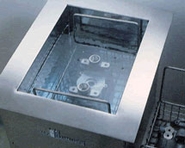
Ultrasonic Cleaning of Automotive Parts

Carburetor Cleaning


Please note: The study below was performed with large high thruput ultrasonic equipment. We sell smaller machines - but the process is the same.

Overview of the Technology

Engineers at NC3R, as a part of their work with NYSERDA, have conducted approximately four months of intensive research into the performance of ultrasonic cleaning. They have evaluated a variety of chemistries and procedures on 14 different part categories. The results of their research are presented here for use by the automotive remanufacturing industry.

 Ultrasonic cleaning is primarily an aqueous tank system
that uses ultrasonic energy to remove dirt, grease, oil,
and baked-on carbon from parts. Contaminants such as
paint, rust, glued-on gaskets, and heavy layers of bakedon
carbon can also be removed by ultrasonic cleaning
but require more aggressive chemistries. Unlike some
other cleaning processes, ultrasonic cleaning will not
damage intricate, lightweight, or easily damaged parts.
Parts that have a tendency to tightly nest will shadow
each other, reducing cleaning efficiency.

Since ultrasonic cleaning is done in a tank, it is by nature
a batch process. The success of the process is very
dependent on the ultrasonics, the chemistry used, part
geometry, and weight of the part.

The chemical cleaner used in conjunction with the ultrasonic
equipment will determine what materials can be cleaned,
how fast the contaminants are removed, and the temperature
of the cleaning solution.

How it Works

Ultrasonic cleaning works by producing sound waves in
liquids. The waves consist of both high- and low-pressure
fronts. The low-pressure fronts are small enough to cause
bubbles to form. The high-pressure fronts cause the bubbles
to collapse. The expanding and collapsing bubbles loosen
contaminants on the part surface and the chemical cleaners
either dissolve or segregate the free contaminants.

As with sound waves in air, ultrasonic sound waves can be
varied by both frequency (pitch) and amplitude (power).
Higher frequencies will produce smaller bubbles and lower
frequencies will produce larger bubbles. Larger bubbles
will typically dislodge large particles and smaller bubbles
small particles. Typical industrial systems are either 25
KHz or 40 KHz, which can handle the particle sizes in the
range of normal automotive cleaning. Ultrasonic cleaning
systems with a much higher frequency are used in the
computer industry where tiny particles need to be removed.

Configuration of Equipment

The most basic piece of equipment for ultrasonic
cleaning is a stainless steel tank with an ultrasonic
transducer and power supply (frequency generator),
and is usually referred to as a benchtop unit. More
advanced units may include features such as heating,
filtration, mechanical agitation, rotating baskets,
ultrasonic power controls, oil skimmers, water level
controls, and frequency modulators to improve
solution degassing.

 No More Solvents!

A carburetor remanufacturer formerly used
manual solvents parts washers to clean
carburetors. This was a very labor-intensive
operation, requiring a technician to spend between
15-20 minutes per carburetor. In many cases, the
carburetor then required additional cleaning in a
dip tank containing caustic soda, followed by a
hot water rinse.

After installing an agitating ultrasonic parts
washer, three carburetors could be cleaned in a
single batch with a total cycle time of 15 minutes,
and only two minutes of labor per batch was
needed to load and unload parts. The manual solvents
parts washers were no longer needed, and
caustic soda consumption was cut in half. The
increases in energy consumption and cost of
cleaning chemistry were more than offset by much
larger savings in labor and waste disposal costs
as shown below:

Energy +$362
Materials (includes waste disposal) -$2,090
Labor -$31,200
Total -$32,928

Because the purchase price of the unit was only $15,000, the
cleaning system paid for itself in only five and a half months.
A five-year CD would have to earn an annual interest rate of
219% to generate comparable financial performance!

Advantages of Ultrasonic Cleaning:
•Able to clean delicate parts without damage
•Able to clean small apertures, blind holes, and crevices
•Able to clean sensitive parts (wiring, plastics) with
relatively mild chemistries
•Does not require line-of-sight for effective cleaning


Disadvantages of Ultrasonic Cleaning:
•It is a batch process
•Large loads are not cleaned as quickly as small loads
due to energy absorption
•Large heavy parts can “shadow” each other or themselves
resulting in poor cleaning
•Extremely thick layers of grease, and grease mixed
with dirt, are slow to remove
•Aggressive chemistries combined with ultrasonics can
pinhole foil and pit some materials

Environment, Health and Safety

The ultrasonic process is well suited to aqueous cleaners. As
such, it provides an environmentally friendly alternative to
mineral spirit cleaners and chlorinated hydrocarbons.
Aqueous cleaners are also safer for workers by eliminating
flammable solvents and the health risks associated with
chlorinated hydrocarbons. Some of the more aggressive
aqueous chemistries used in ultrasonic cleaning equipment
are either strongly acidic or strongly basic, which have their
own health risks. There are many very good neutral pH or
near neutral pH chemistries that do an excellent job of cleaning
greasy and dirty parts. From an environmental
perspective, it is preferable to avoid chemistries that contain
metal chelating agents because of the difficulty in treating
the wastewater to remove the metals.

Waste Management

The type of waste generated from ultrasonic cleaning will
be somewhat dependent on which chemistry is used. The
chemistries which split out oil will have an oil waste stream
from the oil skimmer. The process will also produce sludge,
and eventually the cleaning solution must be disposed of.
The chemistries used in the NC3R evaluation were relatively
benign. None of the spent cleaning solutions resulting from
this project demonstrated hazardous waste characteristics of
toxicity, reactivity, pH, or flammability. In many cases, the
aqueous chemistries evaluated in this project could be
discharged to the sanitary sewer, but that would depend on
the requirements of the local municipality.

Cost of Equipment

There is a wide variety of ultrasonic cleaning
equipment available to the automotive parts rebuilder.
The least expensive units are simple benchtop cleaning
systems about the size of a fish tank, with price ranges
from $2,000 to $7,500. More elaborate cleaning
systems with pumps, air spargers, oil skimmers, and
agitating parts baskets are also available at a cost of
$10,000 to $30,000. The more expensive systems
allow for contaminant removal from the surface of
the cleaning solution, thereby avoiding
recontamination of the part when removing it from
the tank.

How the Chemistries Perform

In general, all the chemistries tested removed oils and
greases along with the attached dirt. Very heavy layers
of grease were only partially removed at extended times
(greater than 30 minutes). None of the chemistries
evaluated removed rust. Strong alkaline chemistries
can remove rust but may be hazardous to dispose of
unless neutralized with acidic solutions prior to
disposal.

 The Bottom Line

Ultrasonic cleaning systems perform best in
cleaning parts that are not extremely dirty, are relatively
intricate, and/or easily damaged by other cleaning
methods. For example, a ball bearing assembly is ideally
suited for ultrasonic cleaning: the part is intricate, is
easily damaged, and typically does not have heavy dirt
loads. Also, a bearing requires relatively high cleanliness
for long life. A similar part would be a carburetor, which
again is intricate, has high cleanliness standards for
optimum fuel flow, and will not tolerate any dirt residue
in needle valves.
Ultrasonics do not perform well on parts with
very heavy dirt loads or very heavy grease layers because
an extended cycle time is required to fully remove
those contaminants.